
The Value of a Child

“The Dog Who Went To Space” by Mila Punwar

I was honoured to have witnessed the unveiling of the inaugural ‘Children’s Plinth’ winning ceramic artwork ‘The Dog Who Went To Space’ at St Martin-in-the-fields last week. The artwork is part of the Mayor of London’s ‘Fourth Plinth Schools Award’ to put creative children centre stage as they paid homage to the Trafalgar Square’s historic Fourth Plinths.

Historically, women and children are often undercounted, deemed invisible, and their achievements not fully celebrated (see recent uproars on the Nobel Prize in Medicine). There are more statues of animals than statues of named women in London. Children are often discussed in a lens of potentials, what they can become, the next generation, and the future. But they are seldom appreciated as beings with intrinsic value, as valid and living contributors to knowledge generation, or valued members of society.

Who’s voice is heard? Who’s opinions are valued? Who is answering and making judgements to these questions? I observe a dominance of (a false sense of) a need for demonstrating entitlement. One has to earn their spot to be in the “room where it happens”. Under a façade of meritocracy, this need to show “added value” structures societal resource allocation and social policies. For example, the same line of reasoning underline the debates on minimum age for voting, eligibility for state pensions, mean-tested welfare system, and provision of health service. The same old Greeco-Roman attitude of citizenship persists: One has to contribute to society in a certain way for one to be recognised as a rightful citizen, a valued being. Initiatives on expanding participation, public and patient involvement, and Equality, Diversity and Inclusion all serve to challenge this old view, and expand: Young people’s merits is their being. You are valued for their being. (extend/substitute young people with any protected characteristics, gender, sexual orientation etc.)

The same old Greeco-Roman attitude of citizenship persists
Photo by Hisham Zayadneh on Pexels.com

Academics and policymakers learn the keywords quickly – to give a voice to young people, and listen; but many young people still doesn’t feel that they have a voice, and their voices unheard. I want to highlight an amazing work led by Dr Lauren Herlitz and a group of young people who produced a podcast episode on their thoughts and experiencing interacting with primary care services. Lauren put the young people’s voices at the forefront, in a direct, raw form that does not filter out their anger and fear in their voices (listen to the podcast). These voices are now transformed into a different voice – as an academic paper, backed by the academic class. In my view, the academic class has the role and responsibility to amplify and project these voices: we are rooted in scientific methods, evidence and rigor, but has to transform and be (always) unsatisfied with the impact of our collective contributions.

The burden is now with us as adults, activists, researcher academic and policymakers. The public is engaged when relationships are built, when actions are seen, when voices are heard, when history and culture is respected. Investment in long-term planning of public engagement is crucial to inclusive and better research and policy-making practices.

I am deeply inspired by Mila Punwar and her ceramics artwork. Listen to Mila talk about her creations. Laika, the dog, was the first living creature to orbit the Earth. Laika died a few days into her mission, partly due to the process, but the crew never prepared for more than 7 days of food. Laika was bound to be sacrificed. Young people’s voices are here to be projected upwards, to the outerspace if need be. Their voices cannot die like Laika.

Who do we value?

The fault in our names – Share your story

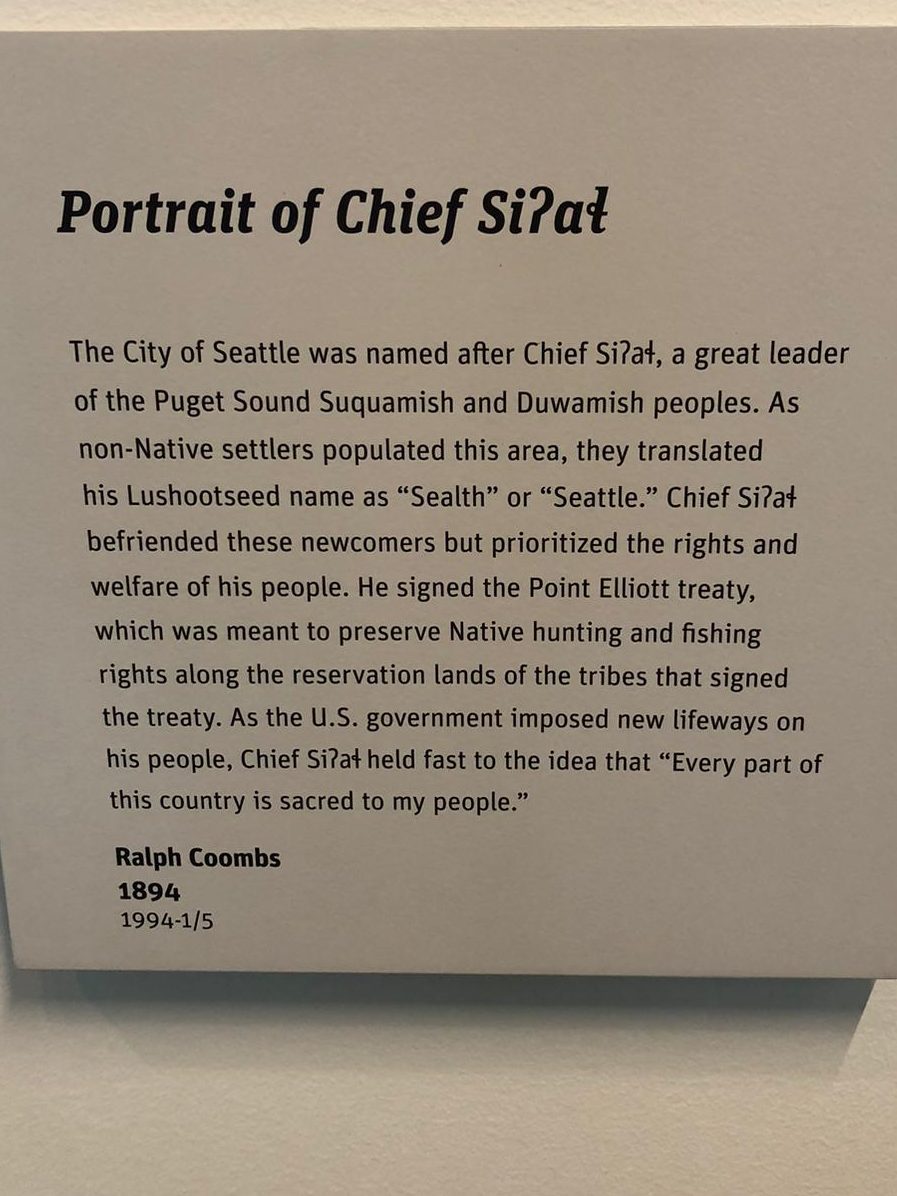
I had the opportunity to visit the Burke Museum of Natural History and Culture at Seattle, Washington. I was greeted by a pair of (portraited) open arms of Chief Si’ahl, the most famous dxʷdəwʔabš chief, whose name was anglicised to – as we now know – Seattle.

Picture of the description text for Chief Si’ahl’s portrait.

I can’t help but think about how Chief Si’ahl’s name would most likely be represented in many different ways in a modern data system. For example, Si’ahl already is a compromised ASC-II representation of his name in his original Lushootseed writing, where non-alphabetical characters are simply not accepted. Even in the anglicised form, his name may be recorded quite differently at different places, namely “Sealth” or “Seattle”. This meant that linkage based on his name would be more difficult than others.

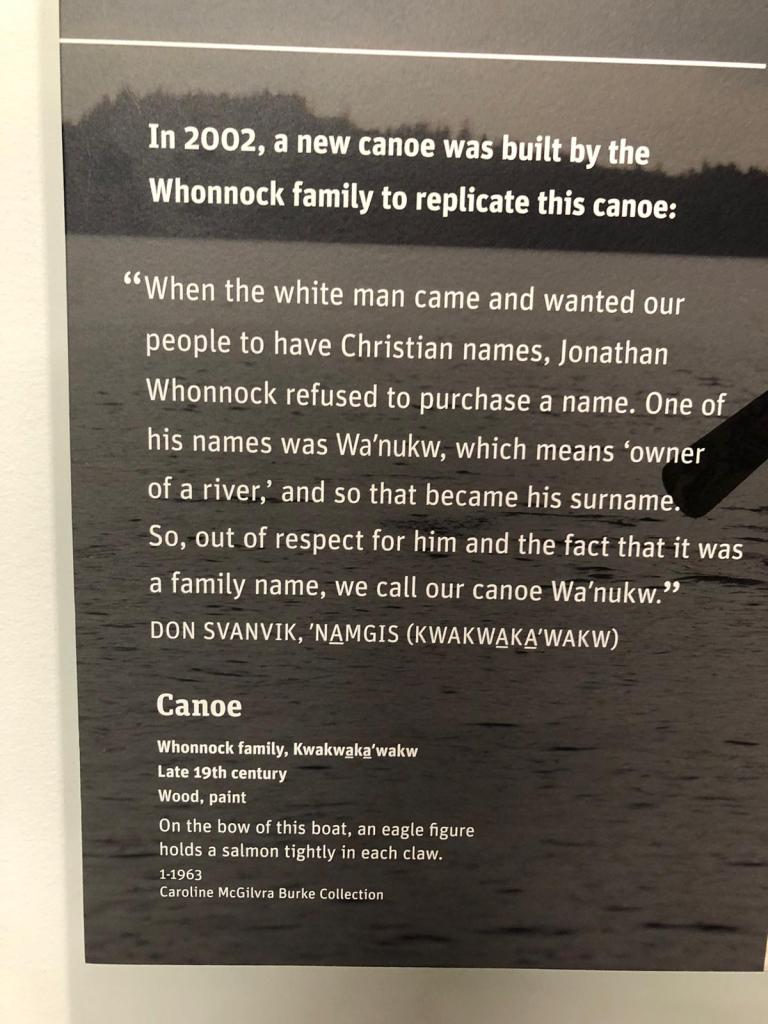
Burke Museum gave me another example of situations when people’s naming systems differ from the Western Forename-Surname structure, they are sometimes forced to conform. Chief Jonathan “Whonnock” (anglicised)’s name is structured as such.

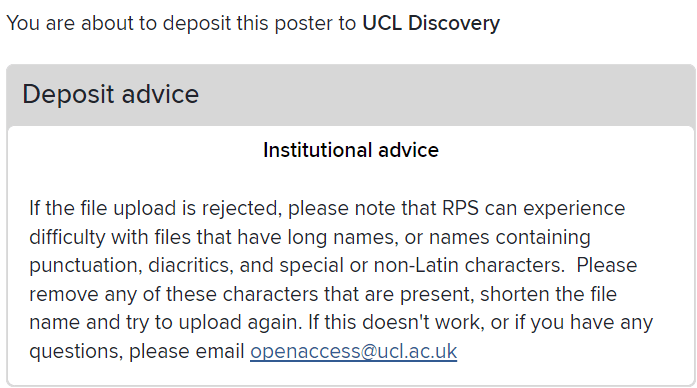
You would be mistaken to think these questionable treatments of names is a thing of the past! I was updating my UCL profile recently, and UCL gave this lovely advice – no names containing punctuation, diacritics, special or non-Latin characters, or names that are too long.

This may be innocent and non-consequential for file names – but you won’t say for people’s names. What truly hurts about “being called names” is about being called names that one does not identify. We live in a culture that claim to respect diversity, but has yet to truly reflect on their practices, in terms of data system design. In terms of data linkage, where names are often used to help identify if multiple records belong to the same person, we have long-established inequalities by racial-ethnic groups – where people from White British groups are most well linked, represented, and included in research. I have written about the technical side of this argument in my own academic work – hopefully out soon (waiting for Arxiv…)!

The Fault in our Names – share your stories.

We need to tell our stories to drive change. I have started a page here to invite your submission to collective tell our story – how our names are misrepresented in data systems, and it’s direct impact on our lives. I hope this will create an archive of our stories, and bring them to light.

One day, our names, all names, will be treated with respect.

That’s Just Common Sense… Or is it?

Esther McVey, A.K.A Rushi Sunak’s “Common Sense” Minister, declared “war against backdoor politicisation” by suggesting a ban of “divisive” rainbow coloured lanyards among civil servants (which caught most of media attention), and a ban on all jobs dedicated to equality, diversity and inclusion (EDI). This probed my curiosity in what “common sense” really meant.

Here’s a quick summary from reading the Wikipedia page (perhaps GPTs would do a better job here but let’s keep this authentic!). Earlier (~BCE 350ish) Aristotelian definition of “Common Sense” focused on the five senses, how there must be a common way in which people (and creatures) perceive the world, tell apart constructs across modalities, for example “sweetness” from “white”. This understanding of “Common Sense” was mostly translated and updated after Enlightenment, in the late 18th Century, to mean a set of collective and conventional moral consciousness, sense or sentiment that doesn’t need reasoning (with Kant standing against the feeling bits). This philosophical line of representing “Common Sense” as an “universal moral law” has been adopted in Catholic and Christian apologetics, such as CS Lewis’ influential book “Mere Christianity”. Across the Pacific Ocean, ancient (~BCE 300ish) philosopher Mencius wrote (English translation) about a similar concept, that humanness is defined by their innate feelings of commiseration, shame, modesty and complaisance. These philosophies shaped our modern understanding of “Common Sense”: (1) very optimistic view of the human condition, (2) universality of this moral judgement that does not require reasoning or reflection, and (3) “Common Sense” is used to define humanness.

Here are a few quick arguments to the “Commonness” in “Common Sense”. *Assessment of the human condition is not relevant to this discussion so I will just say I do not hold the same optimistic view of human nature as Mencius. A low hanging counterargument to (2) is the shift of what’s deemed to be morally acceptable over time, context, society structure and locations. Killing animals for fun was “universally” accepted, until it’s not. Slavery was “universally” accepted, until it’s not. Given (3) is true, with (2) being relative to space and time, accordingly, what defines humanness (3) becomes relative. The key question, hence lies at who decides what is Commonly Good, and when it is no longer Commonly Good.

Rainbows are divisive?

How did Esther McVey know rainbow coloured lanyards are “divisive” and are against “Common Sense”? By definition, there is no need of reasoning for Esther to explain her decision. On a personal level, I acknowledge (accept, but maybe not at endorse level) other modes of “knowing” that does not strictly rely on reasoning. For example, faiths, beliefs, trust, relationships, values can not always be meaningfully explained or metricised and quantified into degrees of reasoning. People are rightfully living by their beliefs, without the need of justifying how they have conceived their beliefs, with or without reasoning. I mean, I still can’t fully understand why people voted for Trump, but I am satisfied to not demand their votes to be reasoned before them be deemed valid, and I can co-exist with them in a democratic society. However, in the public sphere, this way of knowing without reasoning removes the transparency and justifiability of decision-making. Relying solely on this way of knowing re-mystifies politics back to the era of empire-theocracy. The politicians (decision-makers) are left with the opportunity to misuse their power of exceptionality. Reason is required for this reason. Fortunately, in a democratic system, there are still mechanisms to challenge this power – We’ll see when it happens (when’s general election?).

There are several foreseeable practical impact on public servants following Esther McVey’s announcement. This instrumentalised view of civil servants as a horde of machines with assumed neutrality might be preparing for large-scale AI takeover. Jokes aside, this un-reasoned power to put restrictions on people – humans – to express themselves will soon be shooting the already weak civil services in their own foot. There are two kinds of expressions that are being restricted – visible and invisible sense of identities (Back to Aristotelian!). Visible ones are like the example, carrying rainbow lanyards, but could be extended to, say, wearing a hijab, looking too Asian, does not drink, revealing ankles etc… When the expression of personal identity conflicts with what’s deemed to be “divisive” or “Common Sense”, it will always be the individuals’ humanness that are disrespected. Heck, “Esther” too is a name originated in Jewish/Christian traditions, should we move to use numbers to call civil servants during their duty hours (hello again, 1984)? Esther McVey’s attempt to promote inclusion in civil servant workforce serves as a recipe to undermine the exact thing she is trying to improve.

There are wider implications on identities that are invisible. Networks to support people from different religion or country of origin are now suppressed. Role models, peer support that were previously more accessible are now hidden. There is no easy way to identify other people who are similarly minded, who are happy to support, for mentorship, informal chats or discussions. This assumed “neutrality” then, again perpetuates a biased resource allocation system towards people with high capabilities (in terms of social capital etc….), and not potential. The already clunky “machine” Esther hoped to fix will keep on failing her expectations.

Would universities and higher education institutes follow suit? UKRI has made precedent in October 2023 by banning Research England EDI Expert Advisory Group (with independent investigation found no evidence of any breach). Will these bans extend to university staff who are technically publicly funded? I had a rainbow lanyard when I was at King’s College London, would they take those away too?

End with a whip of good news – in the latest news today, the lanyard ban does not appear in the actual guidelines. But it was never just about the rainbow lanyards. More is coming, and next time it might concern you, when your sense of individual and humanness is no longer respected, remember, it’s just “Common Sense”.

Chapter 5 – One (Only) Way forward.

I propose that only via shared understanding, relationship-building, a community that preserves space for authenticity and solidarity can truly achieve meaningful representation – with unity in diversity.

The concept of “Global Village” was born in 1964 by Marshall McLuhan, who illustrated how the technical advancements in communication abolishes geographical and temporal boundaries. There emerged an innocent globalist and cosmopolitanism view that harmony in diversity will be achievable in no time. The Culture War narrative took over, as the after-(ongoing) effect of the economy crisis ripples, as the “compete for survival” instincts kicks back in economic and cultural terms, the harmony in diversity fantasy seems much more far away than it was in the 1960s.

In earlier chapters, I criticised HEI’s approaches in promoting representation. I argued that the current measures of diversity could easily be portraited as performative, quasi-pro-diversity mandates that drains energy from both the dominant and minoritized groups, as the former feels like they’ve been unjustly underserved, and the latter tokenised, seeing little actual improvements.

How then, can we create and preserve a safe and empowering space that community can thrive, with harmony in diversity? In my opinion, there are 2 key attributes to such communities: Authenticity and Solidarity. And both of these attributes can only be demonstrated through patient, non-judgemental listening and communication.

1. Authenticity

I believe that our identity is continually constructed through our interaction with our circumstances, with respect to history, personal struggles, evolves and adapt to our environment. If we truly respect ethnicity as “self-defined and subjectively meaningful to an individual.” (ONS, see discussion on this in Chapter 3), we have to allow individuals, especially young people in HEI, to have the courage to embrace and explore this uncertainty. We have to reject label-driven classifications to pre-determine how we should interact with others. Here’s my story to illustrate this point:

I attended a language class at the university in London, this was not too far from when the 2019 Hong Kong Democratic Movements have made the news in the West. The first few terms we learn after “What’s your name?”, “Where do you live?”, would be – you guessed it – “Where are you from?”. I am in a small class of 10, coming from different countries, ranging from Switzerland, Germany, Poland to Pakistan, Iran, China. We took turns to ask each another the question – where are you from.

There is a stark contrast in the temperature of the room when I said I am from Hong Kong, and my other classmate said that they are from China. I was welcomed with a lot of warmth, and them a much less welcoming acknowledgement. It is no surprise that the China = Bad overly simplified narrative has crept into the classroom, and affected how we treat others. I felt it, and I decided to share with the class the cultural similarities between Hong Konger and Chinese people. The class was less hostile (yes.) as they now can see my Chinese friend more as a person, and not as an extension of the communist suppressor as they may have previously perceived.

The more socially acceptable, easy thing for me to do in that situation would be simply add salt to injury, to explain how Hong Kong is different from China. I chose not to do that as that would further undermine the class as a safe space for my friend to explore his identity. But this is not just for him. I can easily imagine that this act of differentiation would drive me further away from my dual Hong Konger-Chinese identity. I admire a lot of the elements in Chinese traditional culture, the food, the language, the art… Yet there is strong social pressure for me to denounce part of my identity, and only by doing that my social standing in the environment can be affirmed. Knowingly or unknowingly, my self-identity would change, not as a result of authentic, soul-searching, but under the influence of social correctness or social desirability.

An environment that truly enables authentic identity building need not to be value-free, but it requires individuals to be treated with no presumptions that is based on group identity one may be prescribed as having. It means that individuals have to choose the hard way, to not rely on mnemonic devices of ‘labelling’ too much when we meet and interact with others. This leads on to the second attribute – solidarity.

2. Solidarity

A community that endorses solidarity within itself share a key assumption: that every individual in the group is valued as much as the other. There are a lot of discussion on the importance of solidarity so I won’t drill into this too much here.

To highlight how HEI values diversity, a common approach was to collate a long list of cultural or religious events or dates that is happening each month. This was intended to create opportunity for staff and students to demonstrate solidarity with others. I strongly doubt many people read them, or “celebrate with” others. My observation is that, apart from being startled by the sheer amount of “festivals” and “celebrations” that are on the list, the biggest barrier that stops people from “celebrating with”, is the lack of relevance behind those jubilant pictures and exotic foods. I think it is not meaningful to include every festival you can think of purely on the notion of inclusivity. It has to come from the population you intend to share this list with, and it has to be an invitation to “celebrate with” the relevant groups. How do we stand in solidarity if we don’t even know they exist? Representation of non-existing people does not make sense. HEI as a porous community, be it at department, institute, or the University level, must allow individuals to willingly share, and take initiative, and have their skin in the game to allow the above to happen.

Ultimately, the narrative that work and life should be separated, that one’s goal for life is retirement, and that the individuals as just a cog in the system strips people self-worth and sense of community. Under this narrative, your coworkers not worth your time, but another replaceable, disposable piece of work to listen to, understand or build relationship with. But there is no short-cut to diversity and proper representation. There is no laws, rules, or recommended practices that can foster relationship. Authenticity and solidarity needs to be centred at the heart of any diverse community to develop shared understanding. With no understanding, there is no true diversity; with no true diversity, there is no true representation; with no true representation, there is no equity.

An authentic community with individualised understanding and solidarity is key to proper representation, and equity (in the long run).

There is one, only way forward:

“…Thou shalt love thy neighbour as thyself”

Mark 12:31

“There is no panacea, or utopia, there is just love and kindness and trying, amid the chaos, to make things better where we can. And to keep our minds wide, wide open in a world that often wants to close them.”

Matt Haig, “Notes on a Nervous Planet”

End.

Chapter 4: Superficial Representation and True Beaconing

Chapter 4 aims to suggest that HEI’s must challenge the wider underlying philosophy that has shaped the current approach.

Chapter 3 has identified 2 flaws of the current paradigm of promoting representation. Chapter 4 aims to suggest that HEI’s must challenge the wider underlying philosophy that has shaped the current approach and their flaws.

The UK is said to have engaged in the Culture War. It is “us” against “them”, us as the rightful descendants of Anglos and Saxons against the illegal migrants who are diluting the glory of Britannia. Differences are seen as invasive, as threats that needs to be actively suppressed and neutralised. The British identity is to be like us. If you cannot act, speak, think, see like us, you need to be managed. This mentality puts minoritized groups into a mindset of competition, it’s all for ourselves now. Black history month is for black people, Lunar New Year is for East Asians, it is not uncommon that HEI is becoming more eager to recognise differences, but it is unfortunately uncommon that these differences are not really celebrated. There is no platform to display horizontal cultural appreciation and solidarity when every group tries to keep themselves relevant, we are made to compete for higher cultural relevance in HEI, in politics, in society.

This meant that people from minoritized communities are then expected to take up even more responsibilities – you need to fight for diversity, representation, but also fight for the sustenance of your own culture. It is no wonder we feel exhausted and tokenised, as our efforts rarely translate into true cultural changes, as we failed to see enough improvements in our daily lives. We feel tokenised because our existence merely acts as virtue signalling, because we are used to fulfil tick-box exercises. Tokenised because it is always just us speak for ourselves. This divides the minority groups, instigating a “all for themselves” mentality, as difference is framed as threatening, cultural survival is perceived as something to compete for, that only the fittest will survive.

This cultural assimilation narrative does not only affect the minoritized groups, but it also breeds the resentment in dominant groups that were expressed too often in academia towards the minoritized groups. “You must be a diversity hire.” This resentment and grief do not (always) stem from race-based discrimination, although it is often framed this way, this could be instead an expression of anger or discontent towards the seemingly unfair system where the minoritized are rewarded with more merit than they perceived to possess. This perception of unjust is brewed from the current non-transparent and ineffective way of promoting “socially valued” practices, where genuine communications and respect of differences is left out unmeasured, hence of the scene. People expressing this resentment may not disagree with the principles of equality, they might even be strong supporters of the notion, but they were misconstrued with top-down promotion of visible representation.

To enforce these top-down, superficial representation, EDI groups quickly resorted to law and social contracts (that people might not agree). We are told that diversity and representation is valued in HEI, and that discriminatory behaviour will be punished. I argue below that neither of the 2 approaches – legal deterrent or social pressure – address the crux of the problem.

The legal system exists to refrain people from hating each another when they are violated, knowing that any mishaps (defined by law) will be justly punished or reattributed. Social contracts exists to refrain people from loving or caring for each another, when they only need to satisfy the need to demonstrate performative, socially acceptable behaviours to be seen as prosocial. This means that under the social contract of “no discrimination”, people learned that their lack of/unwillingness to love and understand differences will be hidden covertly behind a certain pattern of behaviours. Treating means as goals in promoting EDI becomes a retractive, ahistorical approach that avoids reconciliation and sustains colonial social hierarchy – to continue to see the culturally dominant group as the giver, and the rest of the minority flourishing conditioned on the dominant groups’ approval, that we are never seen as equals.

To demonstrate progress in “Beaconing and Sharing” activities is a key to be awarded the Athena Swan award. If HEI is an epitome of society, (that is, if we can separate HEI from society), beaconing activity must include the active reflection on the philosophy and ideology as we strive to push for a safe and diverse environment for everyone to reach their potentials to the fullest.

My final chapter will hope to suggest what a safe and empowering space for diversity and representation should look like.

Chapter 3: The Flaws of Representation

In chapter 3, I describe 2 flaws of representation:
1) Arbitrary Groupings, Arbitrary Goals
2) Choice of Representation

In this chapter, I will describe 2 main flaws in how ethnicity and ethnic representation is discussed. By the end of the chapter, I hope you can start to see why progress in promoting ethnic equality is slow, and may be illusive.

Flaw 1) Arbitrary Groupings, Arbitrary Goals

Let’s say we take upon the “measurement is gold” mantra, we still have to face the problem that we are constantly moving the goal post of equity, as number of “groups” are ever increased (& prescribed), such that progress is hard to track or make sense of. In the UK, the terms we used to describe minoritised ethnic groups have been changing – people of colour, BME, BAME… And now “It is time we drop BAME” in the Sewell Report. The widening trend and the abandonment of an over-arching term to describe all non-White British people reflects a changing demographic in the UK, and a changing public discourse to use better terms to describe people’s identity. The question lies: Who decides how other’s describe their identity? For what purpose are we classifying these categorically different identities?

The terms we use to describe race and ethnicity is unique to where we are. It is often defined by the dominant groups (e.g., White British). More inclusive terms emerge when minorities were given a larger voice. But these emerging terms do not change the fact that these terms are created by and for the dominant group, and that their group membership do not solely depend on their identity, but depend on the dominant group’s perception. A quick example, people of middle eastern heritage, who speaks perfect English and has pale skin colour is treated vastly different before and after 911. In the UK, from the last 30 years of census, some people groups reported changing ethnic identity, but the ever-stable ethnic identification is White British. Terminology cares less to differentiate Black Caribbean from Black African, but really cares about differentiate “them” from “us”. It is foreseeable that a similar story will unfold, creating more terms and groups to capture “other” groups and “mixed” groups in the UK.

The pattern is clear, ideology is always chasing after the reality: we only care enough to change when there are visibly large enough groups in society that we need to “update our terms”, but not our mentality. In this way, top-down representation or classification into existing categories will forever lag behind, as the UK continues to diversify, as new categories are being created and the goal post of representation will never be attained.

ONS (2003) describes ethnicity as “self-defined and subjectively meaningful to an individual.” Flaw 1 shows the problem of the operationalisation of such measure, that choosing an identity from a limited number of choices that closest resembles our identity, is not truly self-defined, subjective, nor meaningful.

Choice?
Photo by cottonbro studio on Pexels.com

Flaw 2) Choice of representation

We do not choose which country we are born, we do not choose our skin colour. As a migrant minority in the UK, similarly, you have no choice but to represent your visibly perceived ethnicity. Representation starts not when you pronounced membership of the ethnic group, it begins “whenever you step into that space” (Quote from Chineke! Ep4. The Anxiety of Representation). During the pandemic, whenever I step on the tube, I can just hide my Asian-looking masked face to get a free 1-metre quarantine zone, no matter how crowded it is. Every Asian looking person became Wuhan, Chinese. Chineseness is dumb down to a simple dimension of fear.

Perceived membership is not always a good indication of subjective identity. Let’s look at another example. Some migrants from Hong Kong (Hong Kongers) yearned to differentiate themselves from being called “Chinese”. There is an ongoing, traceable, consensual process within the Hong Konger community to build and define Hong Kongness, but this difference is often not respected by Chinese and the wider popuation. This highlights the dynamic nature of ethnic identities, and that visible representation is not sufficient a marker to denote group membership. This varying nature of ethnic identities is not unique in migrant populations. To oppose same-sex marriage in Hong Kong, a lot of conservative politicians claim that it is in Chinese culture and tradition to uphold a heterosexual, monogamy marriage. However, as Marco Wan illustrated in his paper, the traditional Chinese marriage was never monogamous. Chineseness was influenced by (western) modernity in their own invention of their marriage “tradition”. Within people groups of the same ethnic origin, with shared language and nationality, their notion of ethnic identity and what it entails can differ. The attempt of using top-down categories and language to restrict how ethnic identity can vary limits our ability to truly allow people to choose how to express their own.

Non-dominant groups do not have the choice to be un-represented, the “Single Outlier” explanation is never accepted for non-dominant groups. The “Bad Apple” excuse is too often used, and accepted, when say e.g., a White man has breached the law. This is another way of explaining why the “unconscious biases” remains pertinent in the UK, the dominant group rejects any potentially negative connotation linked with their White British ethnicity, but are too quick to label and stick with stereotypes they assign on minoritized groups. The dominant group has to power to choose to be un-represented. “I’m not like those White men.” Can non-dominant groups do the same? Look at the disproportionate rates of stop and search in young black men, the colonial spirit lives on, the same spirit that separated families, enslaved cultures, and maintained the hierarchical caste of social class within the UK. Minoritised groups can’t help but feel like their every step is watched, and that they will forever be the other. The reliance on appearance representation amplifies the power imbalances between groups.

The direct implication of the reliance of appearance representation is the risk of under-representing the rights of the less populated/less vocal “sub-groups” within the same ethnic category umbrella term. The indirect consequence is that it creates an illusion of progress (which can be infinitely perpetuated by keep on moving the goal posts), when the underlying resource allocation system does not change, that people from non-dominant groups are still viewed as lesser.

Chapter 2: Current approach to ethnic representation

Construing means as outcome may overestimate true progression to a more equitable HEI.

21st century is an era of metrics. Measuring and demonstrating impact becomes essential to research publications. This realist “only measurable changes are true changes” perspective dominates how “evidence” is conceived. The same line of logic was applied to promoting EDI initiatives.

We often treat EDI representation as visible representation, as they are more measurable. The aim is to get people of certain membership of a group (e.g., Asian) to attain an ideal proportion in a certain measurement of equity (e.g., promotion). For example, proportion of non-white people on interview panels, international student percentages etc. However, in pushing for a wider visible representation (definition 1) to be achieved, we assumed people who share those characteristics (1) are necessary to represent the groups’ rights (definition 2).

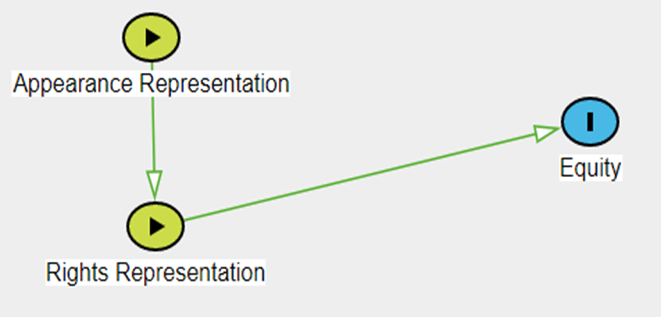
Assumption that AR leads to RR, which in turn leads to Equity
AR is not necessary nor sufficient to attain Equity

For example, in the Sewell report, the ethnic diversity of the police force becomes a target of intervention, with the underlying theory of change that once the (appearance) representation problem is solved, minoritized communities would regain equitable rights compared to their white counterparts. Another example, EDI groups in HEI often require a certain demographic make-up, inadvertently putting pressure on minorities to contribute. This follows the same line of logic that once the EDI group is diverse, the diverse needs will be addressed. There are numerous counterexamples that visible representation do not automatically achieve rights representation, black on black violence, the countless stories about those who made it became the gate-keeper to enter “high society”, hey ho, look at the faces behind UK Illegal Migration Bill 2023.

No doubt, having representation from minoritized groups can be a reflection of underlying change in power structure, equality and resource allocation. But that cannot be the only means of measuring change in our society. As Universities are incentivised to push for different awards recognising their efforts on EDI, when the only outcome measure focuses on superficial appearance representation, we might overestimate our progress to equity.

We need people who can fight for the rights of the underprivileged, and empower the minoritized, such that appearance representation would be the natural outcome of a changed landscape. This is a strong argument for people in power, often White and British, to take initiative. The misplaced emphasis on “measurable” outcomes became a hinderance to progress, as we phantasies for an easily measurable solution. Our current approach to ethnic representation does not promote this vision.

This conflict in apparent progress and on-the-ground experience among ethnic minoritized members of HEI is a source of frustration. I shall touch on this in more detail in Chapter 4.

In the next chapter, I will describe 2 flaws in how ethnicity and ethnic representation is discussed, and hoping to elucidate the power constructs that were so deeply embedded in our social interactions that may slow, or mimic progress in promoting ethnic equality.

* Appearance Representation: A depiction or portrayal of a person or thing, typically one produced in an artistic medium – definition 1.

Rights Representation: The action of standing for, or in the place of, a person, group, or thing, and related senses – definition 2.

Blog Series: Chapter 1: Define Representation and Why It Matters

This is the first part of my reflection serving as a member of the Equality, Diversity and Inclusion (EDI) team at the University. The series is titled: On Ethnic Representation and Equity: The Costs of Conflating Means as Goals.

This is the first part of my reflection serving as a member of the Equality, Diversity and Inclusion (EDI) team at the University. The series is titled: On Ethnic Representation and Equity: The Costs of Conflating Means as Goals.

Introduction

The UUK & NUS report in 2019 reported that less than 2% of 19,000 professors in the UK higher education institutes (HEI) are non-white women. Improving the representativeness of UK HEI staff and students became a priority for Equality, Diversity, and Inclusion initiatives. Proposed solutions included racial equity hiring practices, such as having a more diverse interview board, and purposeful advertisement within the targeted populations. Whilst I appreciate the equity-based approach to improve ethnic representation, I worry that the current framing of “representation” would divert attention away from cultivating a culture that embraces unity in diversity. Despite continual effort, mainly by people from racialised communities, ethnic minorities continue to feel tokenised and marginalised in academia. In this article, I would re-assess the logic behind the current EDI approaches to define and improve representation, point out the intrinsic flaws of the current definition of representation, and propose potential barriers for UK HEI to re-calibrate the direction for improving representation. I argue that the philosophical positioning behind current approaches to promoting EDI conflates means as goals, and might limit our ability to evaluate whether we have truly promoted equity within HEI.

Chapter 1: Define Representation and Why It Matters

“Representation” is typically defined in the following 2 ways (Oxford English Dictionary):

  1. A depiction or portrayal of a person or thing, typically one produced in an artistic medium.
  2. The action of standing for, or in the place of, a person, group, or thing, and related senses.

I will refer to definition (1) as “Appearance Representation” (or Visible Representation), and definition (2) as “Rights Representation”. In my opinion, the need to represent arise as a product of “differences”. For example, “appearance representation” showcases something spectacular, it captures something that is different from the norm; “rights representation” serves the purpose of settling different opinions within or between individuals and communities e.g., legal representatives, political party representation.

Who is HEI trying to represent? What does a well-represented HEI look like? I believe this is determined by 2 main factors: the size of targeted community and school philosophy.

Depending on the size of the institute, the targeted community to be represented should be reflective of the local community (regional, e.g., Lambeth, London), the city the institute is based at (e.g., London), nation or country (e.g., England), or even the world. There is little point for a local primary school of 100 pupils in Kent to be representative of world population, which would mean >90% of White British pupils in Kent would have to compete for <10% of the places, essentially excluding most from education. Similarly, the proclaimed world-class international universities should recruit staff and students that is reflective of their targeted community, or at least their renowned global reputation. This view mirrors that of the suggestion made in the Sewell Report (aka the Commission on Race and Ethnic Disparities), e.g., “to make police forces more representative of local communities”.

School philosophy refers to the beliefs the HEI have regarding the (distribution of) characteristics in an ideal world. School philosophy may take precedent of the size of target population. Take women in academia as an example, it is not as simple as wanting an overall proportion of men and women in HEI that is reflective of the community. It is believed that women are disproportionately lost from academia, and that this has stifled academia from reaching its full potential (premise of Athena Swan). Acknowledging the hegemonic masculinity that persists in society (and academia), extra effort is required to promote and protect the rights and platform for women to develop their academic career. This approach to think about representation considers the social structures of the present and help us avoid reconstructing the inequalities that is presently observed in the community.

In essence, in a well-represented HEI, all groups should be represented, in terms of “Appearance” (in terms of number/proportion) and “Rights” (in terms of platforms/priorities), that is in-line with the institute’s philosophy, and proportionate to the size of the targeted community they are serving.

To be continued…

Hong Kong and the Remnants of Colonialism

Does colonialism still exist in Hong Kong? My 2 recent stories/encounters in Hong Kong.

It has been (at least!) 3 years since I stayed in Hong Kong for more than a month. “What’s changed?” I’m often astounded to realise people are now seeking an outsider’s perspective of home from me… But hay ho I’ve been away for long, long enough to allow me to look at Hong Kong a bit different from how I used to. Today I picked up the post-colonial lens, with my 2 recent encounters/observations in Hong Kong, to make the case of how the western colonial spirit in Hong Kong is far from being a thing of the past.

A view from the Peak in Hong Kong.

Story 1: Short Hike to the Peak

You might have been amazed by unrivalled view from the Peak (a.k.a the Victoria Peak), overlooking the metropolis, all kingdoms of the world under your feet. This is often the first image that pops to my mind when I think about home – I blame the tourism adverts and souvenirs! The hike to the peak is a common route enjoyed by all. European invaders of Hong Kong in the 19th century would concur.

During the long colonial period, the Peak was designated to be an exclusively non-Chinese residential area. However, you could almost convince an unaware tourist that the mandate is still in place in Hong Kong in 2023. There is a very high proportion of non-Chinese people in the Peak area compared with any other areas in Hong Kong (perhaps other than Lan Kwai Fong, where the drinking and clubbing happens). Legal restrictions have transfigured as economical barriers: the most affordable accommodation at the Peak costs in the billions. Apart from luxury flats and houses, you could also find a list of international schools that mostly admit non-Chinese expats kids only. It is like living on stratosphere, no need to learn to read, write or speak Chinese; your social circles never crosses path with the “ordinary” Hong Kong people; you belong to a different class.

I realised this is a source of my unease when someone (in Britain) told me that they have visited Hong Kong. Which side of Hong Kong did they see? Was it the city with the highest number of millionaires by proportion; or the city with the highest level economic inequality in the world? As they enjoyed the horse races at the jockey club, would they recognise gambling was the social device the colonial government introduced to maintain their grips on the people? Were they merely walking in the boots of their fathers, savouring the fruits of their colony; or have they stepped out of the White-only zone, and truly explore this beautiful land? I resort to praise the food every time.

Mark Six, a popular lottery in HK
Accessed from Ken Cheung’s blog on Steemit

Story 2: Short Encounter on the Cable Car

It was a clear and a bright December day. No better day for a cable-car-ride at Ocean Park (a theme park in Hong Kong, watch video below for a virtual cable car ride!). As the cable car climbed the hill, we were greeted by a fellow cable-car rider from another cart down the hill. Most of the time, these are handwaves and hellos that adds a pinch of friendliness and sense of community to the fun-packed trip. Coming towards us that day was a family of 3 – a white, 5-year-old-ish boy standing on his seat shouting, and his seemingly oblivious parents. As the 2 cable cars crossed paths, we recognised what the boy was shouting – a bunch of racial slur directed at Chinese/Asian people. My jaws dropped on the spot, for someone to have the audacity to speak ill of Hong Kong people, in Hong Kong! The young boy likely mean no harm, and it is certainly that he was not targeting us. Heck I would even have to applaud his choice of time and place to do this – such that he would hardly be held accountable. At his young age, he had already learned/or have been taught that he is different – different from the “ordinary” Hong Kong people, that he is no member of Hong Kong people, but a successor of the whip, a higher, better class. The boy is not to be blamed, look around: whiteness remains to be the standard for beauty, a synonym for good reputation, the definition for class. Who should be hold accountable for keeping Hong Kong people the remnants of colonialism?

I love to say to people in the UK that Hong Kong is an ethnically homogenous place – the notion of ethnicity and race is just not in people’s minds. But lest we ignore ethnicity as a building block for meaningful conversations across members of the community, and lest we rule out race as a perpetuating cause for social inequality, and racism as a vehicle for colonialism.

See you soon, Hong Kong, with my very best wishes.

2 barriers to motivation

2 factors that affected my motivation at work: some reflections

Started writing this blog on the 3-month mark of my role. Lack of Motivation has very seldom been a problem for me. Transitioning into my current job, I did struggle with this a bit, especially when I am working from home, with an unstable internet connection and accompanied by a novice flute player downstairs.

I am grateful to be able to be inspired by my mentors and colleagues that has allowed me to reflect on how I work. Here are my 2 barriers to motivation.

1. (In)Ability to Contribute

I’ve received absolutely great support from my supervisors and colleagues. I did not feel like I was dropped into a completely new place with no one to seek help from. People are welcoming, I get to meet new people every now and then. Yet there are still times when I have not felt like a part of the group. The working style in my previous role was quite different from my current one. My previous team is rather spontaneous, we are constantly chasing deadlines, constantly speaking and collaborating with each another. My current role is more structured, things are moving in a slower pace, and it is not very often we get to tackle a problem together. This change of pace and team dynamics mean that sometimes I feel out of place.

In a conversation with my mentor, she noticed that I appear to put a lot of my emphasis on my ability to contribute to the team. Upon further reflection, I think that is very true. I am eager to give, but not just to take. But with my limited expertise and knowledge, I felt like I am in no place to give. And I hope this is not based on mindless patriarchal desire for people to listen to me, but to position myself as a valued member of the group and community, instead of a recipient of charity and welfare. My double-identity as a staff and a student also plays into this. I was heading to a blind alley with this train of thought, and it sometimes then stripped my focus away.

My mentor spotted a gap in my way of thinking. Contribution doesn’t always have to be about knowledge and expertise There are all kinds of contributions. Being kind, active on Teams chats, willingness to listen, responsive to emails, sharing my own perspectives and stories, smile… There are many ways how my presence could help make the team better. That helped me remember that me, as a person, has much more to offer than a domain specific knowledge. I care about equality and inclusion, I care about workers’ rights, I am eager to rise people up. These all shall anchor me as a valued member of the community. Motivation follows.

2. Stress to Represent

We talk about gender/ethnic/any representation a lot in our society. Being the “one” in group appears to be magical – it’s the fundamental step of a building fairer world. That is all good.

But there is a, perhaps, unintended consequence that comes with the above narrative. People from minoritised groups are always under a stress to represent. This stress comes from multiple directions:

a) Am I representing my ethnic group well enough? Will my inadequacy hinder my groups’ already small chances to progress in life? There is this constant worry that it is not enough to be just as good as everyone else. One have to do well in every part of life: always dress smart, be professional, don’t make mistakes and stay on the safe side… And that is not always “me”.

b) Is how I am representing “ME” a product of conformity with social expectations of who I should be? Should a HongKong/Chinese person always be good at Maths, a little bit timid in social interactions, be a diligent worker, bad a driving… It is not about the positive or negative conations of these impressions, but rather questioning, is how I was perceived by others truly comes from me, or is it a implicitly implied characteristics that I should have in order to be socially accepted as a person coming from that particular cultural group.

This thought coincides with point (a), if I am not demonstrating characteristics that would fit a public understanding of how Chinese people should behave – and these characteristics could be positively or negatively judged upon, how would then my fellow people be perceived?

Represent. Represent. It is counter-intuitive to think that the burden of representation is laid onto 1 person- no single person could fully represent any group, which is intrinsically a combination and emergent identity that no single person can fully grasp. We often set our EDI recruitment goal at a merely the representation level reflected by descriptive demographics. Yet 1 is miles away from demonstrating diversity WITHIN any given group.

Being a One/few-in-many does shape my self-perception. The process and reflection I describe in (2b) above is dynamic. It could well be that over time, that I become more and more similar to the media-portraited image of a Chinese person. It might not be a bad thing either. But perhaps I am not yet ready to represent this label. Perhaps I need to know myself more before I could allow others to learn about my group, and the difference between the two. It would be much appreciated if this process of self-discovering is not needlessly pressured to accelerate, that I won’t have to force to choose the group I am not ready to represent.

I am grateful for my current workspace, that I have the luxury to think about and reflect on these things that interfered with my performance. Some of these, like (1) could be resolved, but other (2) would require a change in societal attitudes towards in-group, towards others, and towards ourselves. I hope this would help motivate you a little bit too 🙂